

Primary Text Types
Scribal Methodology
We can verify historical figures through this methodology: examining manuscript records. Our knowledge of Julius Caesar, Socrates, and Jesus relies on this same evidentiary path, the manuscripts that scribes copied, translated, and transmitted to us today.
Consider the examples: Julius Caesar is accepted as dogmatically historical with approximately 50 surviving manuscripts. Socrates has zero surviving manuscripts of his own writings, yet scholars universally accept his existence through accounts by Plato and Xenophon, plus Aristophanes’ contemporary satirical play The Clouds. People continue to model their lives after Socratic philosophy despite this sparse direct evidence.
Jesus, by contrast, has approximately 5,800 Greek New Testament manuscripts, plus ~10,000 Latin manuscripts and ~9,300+ in other languages, which is far more attestation than either Caesar or Socrates. Yet his existence has been historically debated and denied, while Caesar and Socrates are accepted without question nor doubt.
This reveals an epistemological double standard: we apply stricter evidentiary standards to Jesus than to figures with demonstrably less manuscript support. This inconsistency deserves scrutiny when evaluating historical claims about figures who continue to shape our world today.
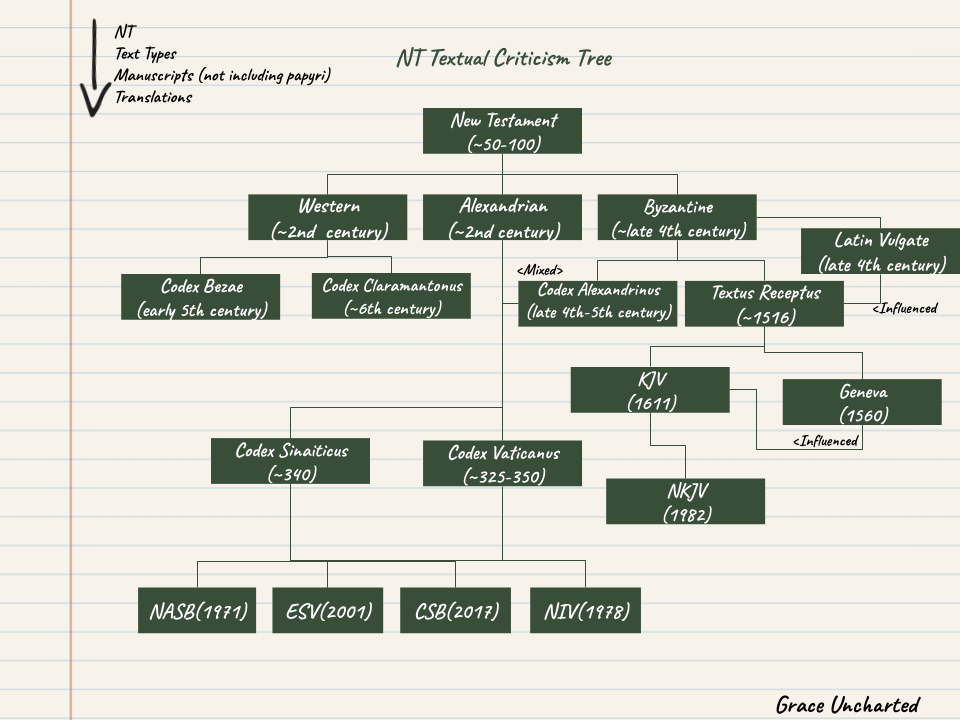
Alexandrian
➢Alexandria, Egypt
The Alexandrian text variant is what the most popular modern English translations align with today—One might wonder why that happens if Byzantine is the so-called “Majority text” and the Alexandrian manuscripts actually date to be older. Less than 1% of surviving manuscripts are of the Alexandrian tradition. Although, the rediscovery (spanning through the 19th-20th centuries) of ancient papyri and uncials like Codex Sinaiticus and Codex Vaticanus brought a new lens to biblical scholarship. And although it is a minority text type, the majority of modern day commonly used Bible translations (ESV, NASB, CSB, NIV) can be accredited to the Alexandrian family. The Alexandrian text type is known for having the most significant absence of text, such as the shorter ending of Mark and shortened Lord’s Prayer along with several other shorter readings.
Byzantine
➢Antioch&Constantinople
Perfect Preservation
- Salvation is found only in Jesus Christ who is the way, the truth, and the life [John 14:6, Acts 4:12, John 3:36]
- Eternal life is God’s free gift that has been given and not a reward that can be earned by our “good works”. [Galatians 2:16, Galatians 5:6, Romans 6:23, Ephesians 2:8-9 …]
No related posts.